Comprehension refers to the understanding and interpretation of what is read and is a process that takes place before, during and after reading to make meaning. Effective approaches to teaching comprehension involve explicitly teaching strategies, building engagement and motivation, building one’s own awareness of one’s thinking, also known as metacognition and most significantly, it also requiring that readers are able to decode and read with fluency.
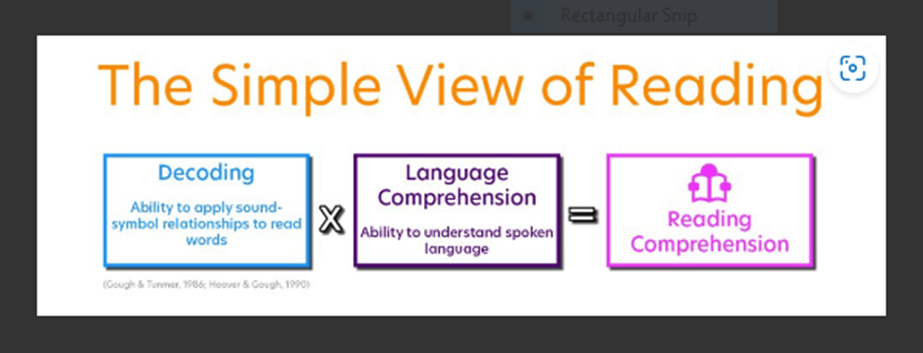
The simple view of reading (Hoover & Gough, 1990) is a theoretical understanding of comprehension as a product of being able to decode words and having the language comprehension needed to comprehend text. If students are weak in either or both of their decoding skills and their ability to understand language, this results in poor reading comprehension. This model addresses the importance of teaching foundational skills in reading, such as phonics, but also providing the opportunities for oral language, background knowledge, vocabulary, language structure, literacy knowledge and verbal reasoning that is part of language comprehension.
Comprehension Assessment:
- CORE Reading Maze Comprehension Test (CORE Assessing Reading Multiple Measures)
Comprehension Sample Activities:
- Paragraph Shrinking
- Story mapping or graphic organizers
- Comprehension monitoring (e.g., 2 column note-taking, summarizing)
- Reciprocal Teaching
- Question-Answer-Relationship (QAR)
- Proficient Reader Strategies from NOVEL Approach:
- Purpose
- Visualization
- Background Knowledge
- Connections
- Monitoring Comprehension
- Determining What is
Important - Inferences
- Synthesizing and Evaluating
- Literature Circles (see resources below)
Comprehension Resources:
- Readworks.org (levelled non-fiction passages with vocab and comprehension activities)
- Newsela (levelled reading passages)
- Florida Center for Reading Research
- The Reading Comprehension Blueprint (book)
- CORE Teaching Reading Sourcebook
- AdLit (All About Adolescent Literacy)
- Keys To Literacy (key comprehension teaching strategies)
- Grand Conversations, Thoughtful Responses: A Unique Approach to Literature Circles Second Edition by Faye Brownlie (Author), Leyton Schnellert (Foreword)
- Literature Circles: Teaching Argument, Persuasion, and Reasoning 2nd Edition by Harvey Daniels (Author)
- Mini-Lessons for Literature Circles by Harvey Daniels and Nancy Steineke
- Read Write Think: Literature Circles Getting Started
- Reading Power by Adrienne Gear. See also her blog for “Top Ten Tuesday” book recommendations.
- Mattawa Education and Care Centre: Teaching Strategy
Go to:
 Curriculum Connections