What is literacy screening? Why is it important?
- A Literacy Screener is a quick, evidence-based tool designed to assess students’ foundational reading skills through a series of targeted measures. These assessments help educators identify students who may be at risk for future reading difficulties, allowing for timely and effective intervention (Perry, 2025).
- Screeners are administered to most students multiple times throughout the school year to monitor progress and to inform instruction. There are a few instances where the screener may not be appropriate for select students (example, students with limited verbal skills, fluency-based speech disorders, complex medical profiles), in which case teachers may choose to administer other assessments more suitable to the student. A screener that targets literacy skills can be used to gauge where students are in their development of foundational reading skills, such as phonemic awareness, letter recognition and decoding skills.
According to the K-3 Early Literacy Screening Tools Resource (2025), all early literacy screening tools should be:

- Link to Early Literacy Screen Tools Resource (POPEY & Ministry of Education and Child Care)
Why are Literacy Screeners Standardized?
In standardized screeners, teachers follow detailed directions to administer the assessment tool the same way for each child to accurately reflect their literacy skills. This ensures that the assessment is consistent, reliable and that the early literacy screening results are valid and therefore, informative.
Standardized screeners also allow for benchmarking against established norms or standards from tens of thousands of results from students of similar age groups. This helps teachers gauge how students are performing relative to other students in the same grade.
There are a few instances where accommodations may be considered and used, particularly for students who have an Individual Education Plan (IEP), a Student Intervention Plan (SIP), or an Annual Instructional Plan (AIP).
How Does Screening Connect to the B.C. Curriculum?
“Early literacy screening is intended to determine where students are at regarding their reading skill development and identify students who may require additional supports and/or interventions. While early literacy screening tools do not fully assess the learning standards of the B.C. curriculum, information provided can be helpful in instructional decision making” (K-12 Literacy Supports Initiative Frequently Asked Question).
- Link to access K-12 Literacy Supports Initiative Frequently Asked Questions
The Ministry of Education also released the K-4 English Language Arts Foundational Learning Progressions in June of 2025. The K-4 ELA Foundational Learning Progressions include descriptors of proficiency in key aspects of the ELA curriculum, including oral communications, phonics skills, grammar, and vocabulary. It is intended to be used as a scope and sequence for educators to determine if students are on track in reading, writing and oral language. Many of the measures in the universal screeners target the literacy skills highlighted in the K-4 ELA Foundational Learning Progressions and can be used to assess whether students are on track:
- K-4 ELA Foundational Learning Progressions
- Kindergarten ELA Foundational Learning
- Grade One ELA Foundational Learning
- Grade Two ELA Foundational Learning
- Grade Three ELA Foundational Learning
- Grade Four ELA Foundational Learning
Early Literacy Screening Tools:
The Ministry of Education has recommended three recommended commercial screeners for early literacy screening. Here is a comparison chart of the three recommended tools:
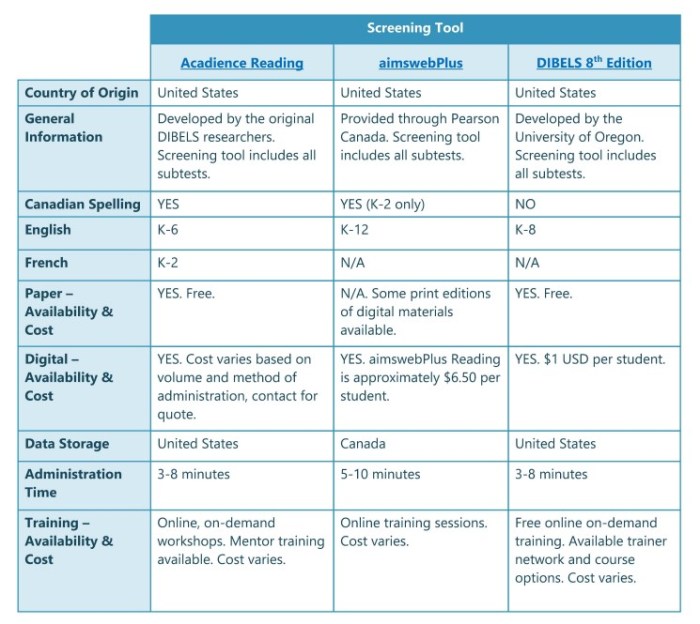
(Source: Early Literacy Screening Tools Resource)
Why Do Screening Tools Include Timed Measures?
Screening tools often have timed elements to help teachers assess the automaticity and fluency of the skill being demonstrated, which is an important component of overall reading success. It is important to note that teachers need to be discreet with timed tasks, as timed measures can make students nervous. For example, in many of these measures, you can start the timing when the student begins to read and ensure that the device used to time is not within the student’s view.
More Information About Screening Tools:
- Link to read more on screeners here from Dyslexia Canada
- Professional Learning Series with David Fainstein and hosted by POPEY
- FAQ Playlist of videos and answers to some frequently asked questions about universal screening tools from Ontario’s ONlit organization
MPSD Early Literacy Screener:
More Information:
- Literacy Assessments
- Diagnostic Assessments
- ELPATS Assessment (password protected for MPSD educator use only)
- Comparing Assessment Tools
- What’s Next after Screening
 Curriculum Connections